How My Stained Glass Is Made
01 · Design
02 · Selecting the Glass
02 · Selecting the Glass
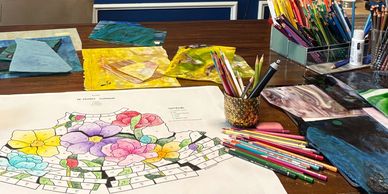
The design phase often takes the longest—and is where the piece first begins to take shape. I start by exploring ideas, gathering references, and sketching possible compositions. From there, I refine the drawing line by line, making sure each shape can actually be cut from glass.
Once the linework is complete, I create a color map to begin planning the palette, value, and movement of the finished piece.
02 · Selecting the Glass
02 · Selecting the Glass
02 · Selecting the Glass
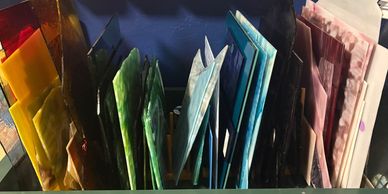
Glass selection is about much more than finding the right color. I consider texture, transparency, pattern, movement, and how each piece will behave in changing light.
I work from the glass in my studio and source additional glass locally when a project calls for it. Sometimes the character of a particular sheet even influences exactly where a pattern piece is placed.
03 · Cutting the Glass
02 · Selecting the Glass
04 · Grinding & Cleaning
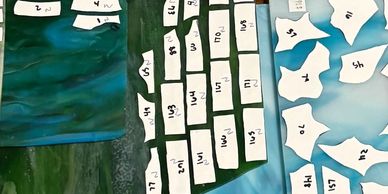
The pattern is transferred onto the selected glass, and every individual piece is cut by hand. Using a glass cutter, I score the surface and carefully break away the surrounding glass until the shape begins to emerge.
Some cuts cooperate beautifully. Others require a little more patience—and occasionally another piece of glass.
04 · Grinding & Cleaning
04 · Grinding & Cleaning
04 · Grinding & Cleaning
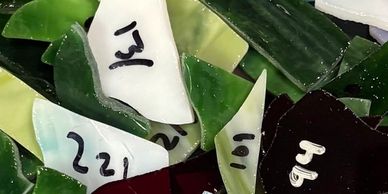
Once cut, every piece is taken to the grinder to refine its edges and bring it precisely into shape. This allows the individual pieces to fit together properly and prepares the edges for copper foil.
Grinding is messy, wet, loud, and not particularly glamorous—but there is something incredibly satisfying about watching all those separate shapes begin to fit together.
05 · Copper Foil
04 · Grinding & Cleaning
06 · Flux & Solder
.jpg/:/cr=t:34%25,l:13.59%25,w:62.5%25,h:23.44%25/rs=w:388,h:194,cg:true,m)
Each piece of glass is wrapped by hand with a thin strip of adhesive-backed copper foil. The foil is carefully centered around the edge and burnished tightly against the glass.
This creates the surface that the solder will eventually bond to—and turns dozens of individual pieces into something that can finally become one.
06 · Flux & Solder
04 · Grinding & Cleaning
06 · Flux & Solder
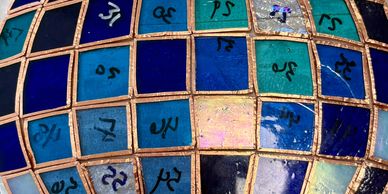
The foiled pieces are returned to the pattern and fitted together. Flux is applied to the copper, and molten solder is carefully worked along every seam.
The solder joins the individual pieces into a single structure while creating the distinctive lines associated with Tiffany-style stained glass.
07 · Finish & Polish
07 · Finish & Polish
07 · Finish & Polish
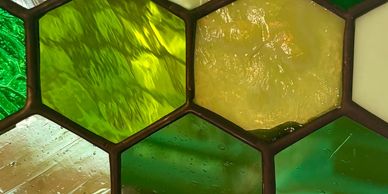
Finishing a piece takes more work than it might appear. The glass and solder are thoroughly cleaned before patina is applied, transforming the solder lines to their final black or copper finish when the design calls for it.
The piece is then cleaned again and polished to bring out the depth of the glass and the finish of the solder. After many separate steps—and many separate pieces—the artwork is finally complete.